Showing posts with label art blog. Show all posts

Wednesday, September 28, 2022

Norman Garstin: The Irish Impressionist

 It seems that the Impressionist Movement traveled far and wide. Previously, I've posted about the Russian version. Today is about the Irish version as portrayed by Norman Garstin (1847-1946), who was born in County Limerick, Ireland.
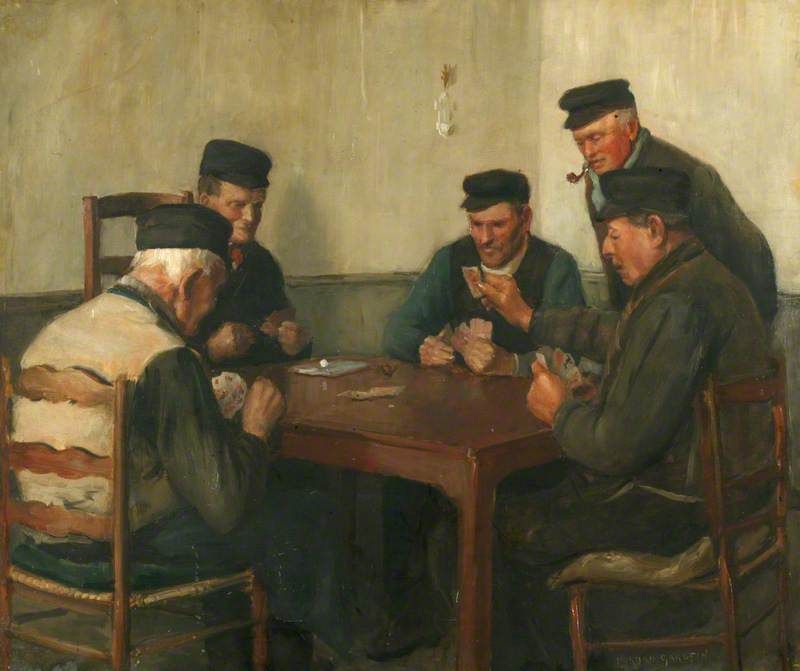


Garstin finished college and worked at architecture and engineering for a bit when the travel bug got the best of him and he began his wandering. First, to South Africa where he worked in journalism with Cecil Rhodes. However, his interest in art and learning next took him to Antwerp, Paris, Spain, Morocco and Venice.


He eventually settled himself and his family in Newlyn, England. However, he continued to conduct teaching plein-air to student groups in his favorite European settings.  


Garstin's influences were not only Impressionism and plein-air, but also Japonisme along with many of the other Impressionists such as Van Gogh, Mary Cassatt and Claude Monet.


His reputation was as a stimulating teacher and shrewd critic with an eye for old architecture and historic atmosphere. As an Irishman, he had his share of intense impulsiveness and opinions on many topics, especially war. Now, that's the definition of a true paddy! 


Wednesday, September 7, 2022

Masayo Fukuda: The Evolution of Kirie Paper Cutting

 As many of the fans to this art blog already know, I'm deeply impressed by paper artists. Using the most common of materials, they create stunning works of art. Today's artist takes paper cutting to a very high level.


 Masayo "Kiriken" Fukuda was born in Japan, studied art in college and went to work as watch repairer. Along the way, she learned how to manipulate tiny tools such as screwdrivers and tweezers, That experience plus the gift of excellent hand dexterity, would lead to the extraordinary mastery of "kirie."


Kirie is Japanese for "cut-picture." Fukuda started as a teenager cutting out greeting cards for her friends and family. She found that the cards were too thick to make for easy cutting. She experimented and refined her techniques. 


Today, she sketches on a single sheet of very thin paper, As if that fact isn't enough, she's also taken the art of kirie to an even higher level.


Most kirie is flat two-dimensional. Fukuda creates the appearance of the final piece as having depth. This method requires her to sketch on the back of the paper, just as a printer, on the reverse. Furthermore, to continue the look of depth, she varies the thickness of the cut lines. This is all remarkable and very unusual. 


Her lyrical, lacy art has been shown in throughout Japan and at the Louvre in Paris. She also has made YouTube videos of her techniques and a book. 


Wednesday, June 1, 2022

The Mark Tobey/ Jackson Pollock Debate...


In an art publication, I read that Jackson Pollock, the famous abstract expressionist painter known for his "drip style," took great pains to deny that his work was influenced by the work of Mark Tobey. Evidence suggests otherwise. (Unlike Pollock's non-denial of Janet Sobel, who was the subject of this blog in March, 2022, which you can find in the archives.)

Before describing the evidence, let me introduce you to Mark Tobey (1890-1976). Does the name sounds familiar? If so, he was known as one of the  "4 Mystical Painters of the Northwest" and a founder of the Northwest School (of art style).  (The other 3 were: Morris Graves, Kenneth Callahan and Guy Anderson)

As a young man, Tobey had converted to the Ba'hai faith. The study of his faith, as well as his travels through Europe and the Orient, led to his interest in Asian arts. He studied haiku (Japanese essential poetry), Japanese brushwork, and Chinese, Arab and Persian calligraphy. 


He also stayed for awhile in a Zen monastery. In time, all of these experiences would influence his art and not only lead to abstract art work, but also to what Tobey referred to as "white writing." 

  Toby experimented with combining painting and calligraphy for spiritual meaning. He would overlay the painting with white (or another light color) in an interwoven brush stroke style. His method would give rise to what is known as an "an "all-over" painting style.(His "Broadway" painting on left.)


Now, dear reader, back to Pollock... ...evidence shows that Pollock attended every exhibition of Tobey's paintings. Often, Pollock would attend an exhibit and then return to his studio and create a very large all-over canvas mural. Below on the right is a Tobey painting and on the left is a Pollock. What do you think? Do you think Pollock really was influenced by Tobey? 


Tuesday, May 24, 2022

Hagino Noriko: Rare Metal Sculpting


What artist can do with materials often seems like a magic show. That's exactly how I felt when I saw Hagino Noriko's (1949-Japan) works. 


At first glance, I thought that I was looking at blown glass or glazed ceramics. Neither could be further from what material Noriko used. These stunningly beautiful vases were made of metal!


After art school, Noriko apprenticed with a master of Hagiawase. Here's the description of the technique I found online: "A hammering technique whereby metals of different kinds are soldered together to form the body of the vessel. Joining of the metals is achieved by the use of ginro (lit. 'silver wax'), which is silver mixed with traces of brass."


Using the natural colors of the various metals - silver=white, copper=red and an alloy of gold & copper=a red-gold - as examples. Noriko uses the arduous process of hammering, forging and welding her works into the very fluid designs shown here.   


Noriko estimates that each of these unusual flowing metal art objects takes her about 6 months to complete.  They are so beautiful and precisely made that gallery prices are about $20K.

So, when I win the lottery... LOL!