Showing posts with label art nouveau. Show all posts

Wednesday, February 8, 2023

Muller Frères: From Art Nouveau to Art Deco

 Last week, the post was about Émile Gallé, an artist, designer and innovator in the time of Art Nouveau. He trained many who want to intern in the art of glass. Amongst these interns were the members of the Muller family.


Muller siblings were many, lead by Henri Muller, who left Gallé with 4 of his brothers to start a glass company of their own. In time, they were joined by a sister and 3 more brothers to make "Muller Frères" a family glass business.


At first, with the influence of their mentor, they designed Art Nouveau glass items. In time, with the beginning of the Art Deco era in the 1920 to 1930s, they created electric light sconces, desk lamps and overhead lighting along with vases and other furnishings. However, they're best remembered for their lamps and chandeliers.


With the start of WW1 and the death of a brother, the business was shut down. The siblings came back together after the war. The family team would go on to great success through the 1920s. Alas, the Great Depression would hit their business hard and the factory stopped production in 1933. 


One thing that's important in writing this blog is to try to give a sense of the artists' body of work.In addition their original Art Deco lighting designs, I've included a few of their gorgeous vases.    


Wednesday, February 1, 2023

Émile Gallé: The Forgotten Art Nouveau Master


Art Nouveau was at its peak from 1890-1910. The style reigned in art, architecture, furniture and even clothing. It was a means of bringing nature, especially abstract versions of plants and floral, into sinuous and flowing motifs. One of the art forms that thrived during that time was glass as a medium. It lead to a resurgence of stained glass as well as appreciation for blown glass and molded glass.

There are some names known for the beauty and innovation of their glass works such as Lalique and Tiffany. Yet, there were others who created equally beautiful glass objects, but whose names have not continued into the 20th century and beyond. Among that group is Émile Gallé (1846-1904), This is in spite of his reputation as one of the most innovative Art Nouveau glass designers.  

Gallé's innovations included such techniques as glass marquetry and patinated glass (the latter technique he patented).


He also experimented with inorganic compounds and metals to create new colors - many adopted into common usage by other glass makers.


His glass works were considered to be the finest glassware on the market with their beautiful forms, rich color and inspired decoration. Today, if you are in Nancy, France, be sure to view the 400 pieces of his glass works and ceramics at the Musée de l'École de Nancy.


One last thing: Gallé's talent wasn't limited to glass, he also created beauty in ceramics and furniture. Perhaps topics for another time... Next week: His interns who became famous for Art Deco glass works.           


Wednesday, October 19, 2022

Anton Seder: Major Designer of Art Nouveau


 Art Nouveau was very popular art form inspired by natural forms that began in 1890. It was the most popular from then until 1910.The style was represented by flattened and abstract objects with sinuous and flowing forms. 

A highly recognized artist, designer and art professor in this form was Anton Seder (1850-1916). He was born in Munich, Germany and trained as a painter, sculptor and architect. Later, he became the first director of the Ecole Supérieure des Arts Décoratifs, founded in 1890, in Strasbourg, Alsace. (now France)

Three years after becoming the director, Seder would submit the winning design for a new building to house the school. It is a beautiful campus and the building looks quite imposing. Here's a couple of photographs to try and capture his hand in Art Nouveau. (If you're a fan of this art form, you might enjoy visiting there on your travels.)


Besides Seder's teaching and his design for the school, he was also involved in gold and iron works for a church and wrote at least 10 books in 11 years! His books are still available and as recently as 2020 there was a calendar printed of his Art Nouveau designs.

Alas, post WW1, there was a shift in the "modern" style of art towards Art Deco. In many ways, it's the opposite of Art Nouveau with its geometric patterns and Asian influences. Seder would live long enough to be criticized as his work went out of style, but not long enough for him to evolve. He was such a brilliant man, one can only wonder what he might have done.


Tuesday, August 2, 2022

Victor Horta: Architectural Innovator of Art Nouveau

 In this blog, I have written about painters, sculptors, and printers but little about architects. It was not an oversight. It was because many avant garde architects such as Gaudi and Gehring have been widely recognized. Then, I came across Victor Horta (1861-1947) who has been called, "the key European Art Nouveau Architect." 


Born in Ghent, Belgium, Horta was educated in music, art, design and architecture. Early in his career, he began to work with iron and glass - often thought of as hard and angular materials. Horta designs wove them into sinuous shapes for both the exterior and interior. 


He designed a few houses, but quickly moved on to designing public buildings. His signature design was the whiplash curves which you can see in the photos here. These have a certain feeling of plant tendrils and became part of the description of the Art Nouveau period. 


  After WWI, Horta moved from the curving, sweeping style to a more geometrical one. This evolution would lead to Art Deco and Modernism. However, modernist felt no connection to Horta's Art Nouveau style and several of his buildings were demolished in the 1960s. 
 
UNESCO stepped in and preserved some of Horta's houses and buildings as World Heritage Sites. We are lucky to have these beautiful designs.
 
Here's more examples of the detail in Horta's works:


Tuesday, February 14, 2012

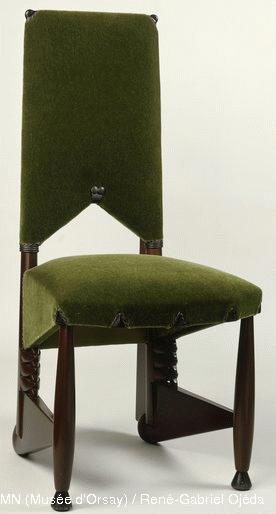
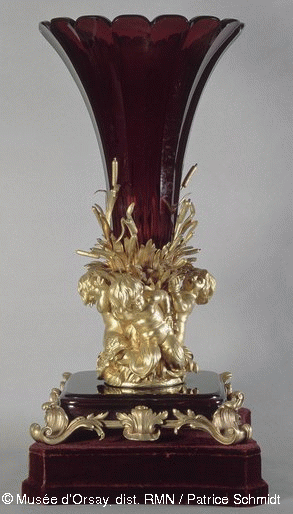
Jewels, Furnishings and Furniture at the Orsay

This is the third and final blog in the Musee d'Orsay series. We've shared a trip to the museum, a look at the visual arts and now it's the "Decorative Arts."

The collection covers 60 years of some of the most innovative times for furniture, furnishings, ceramics, glass and jewels. It spans from Neoclassicism to Industrial (Arts & Crafts) to Art Nouveau.


FURNITURE:


FURNISHINGS:


Monday, March 14, 2011

Victor Horta and the Whiplash Curve

In this blog, I have written about painters, sculptors, and printers but never about architects. It was not an oversight. It was because many avant garde architects such as Gaudi and Gehring have been widely recognized. Then, I came across Victor Horta (1861-1947) who has been called, "the key European Art Nouveau Architect."

Born in Ghent, Belgium, Horta was educated in music, art, design and architecture. Early in his career, he began to work with iron and glass - often thought of as hard and angular materials. Horta designs wove them into sinuous shapes for both the exterior and interior.

He designed a few houses, but quickly moved on to designing public buildings. His signature design was the whiplash curves which you can see in the photos here. These have a certain feeling of plant tendrils and became part of
the description of the Art Nouveau period.

After WWI, Horta moved from the curving, sweeping style to a more geometrical one. This evolution would lead to Art Deco and Modernism. However, modernist felt no connection to Horta's Art Nouveau style. Several buildings were demolished in the 1960s.

UNESCO stepped in and preserved some of Horta's houses and buildings as World Heritage Sites. We are lucky to have these beautiful designs. So, if you're ever in Belgium...