Showing posts with label northwest artist. Show all posts

Wednesday, February 22, 2023

Morris Graves: Mysticism & Asian Aesthetics


It was an assignment in an art class to report on a dead 20th century Northwest artist who was accomplished enough to have a body of work and have been known in their lifetime. That's how I came to find out about Morris Graves (1910-2001).

He was native Northwesterner (Fox Valley, Oregon) and a born artist. His parents had no idea what to do with the little artist. They were sure his fate was to be penniless.


Lacking guidance, Graves wasn't sure of his direction either, so at age 18 he joined the Merchant Marines. A voyage through the Orient would prove to be one of the most profound influences on his art.

In spite of being largely self taught, at age 23 he won first prize at the NW Annual Show held at the Seattle Art Museum. (By age 26, Morris had his first one-person show at that museum.)


 From 1935 to 1954, Seattle had an informal art community. The artists group included Graves, Mark Tobey (who influenced Pollock), Kenneth Callahan and Guy Anderson. Together, these four artists heavily influenced each other, so that they were referred to as the "Northwest School of Masters." During this time, Life magazine placed the four on the cover of an issue with the title: "The Mystic Painters of the Northwest." 


They were called mystic painters because they all sought understanding of themselves and their relation to the cosmos including Eastern concepts of consciousness and creation. Graves studied and used Taoist, Buddhist and East Indian symbolism in his paintings.

Throughout his lifetime, Morris would produce art that was sparse and beautifully illuminated. This is where viewing his art provides so much more than a photo.  (Quite a few pieces of his art are in the collection of the Jordan Schnitzer Museum of Art located on the University of Oregon campus and the Morris Graves Museum of Art, Eureka, CA)


At the end of this life, he requested a painting titled, "Triumph" be brought to him. He looked at it and saw not tulips, but angels rising to the heavens and so he, too, departed. To the end of life, Morris saw and created mystic symbolism.  


Wednesday, January 18, 2012

Porcelain Beauty

How often have you heard or read of someone having "porcelain skin?" What comes to mind? Probably something like, white, translucent and flawless as described for the finest porcelain china. Did you know that porcelain didn't start out that way?

Porcelain was created in China starting about 100 CE. The first Chinese experiments were anything but white and flawless. What made porcelain popular was that it could be fired in a very high kiln making it more durable than clay. It would be another 400 years before the Chinese created the porcelain we know today.

Once the Chinese had mastered the means to create white porcelain and control the glazes, artists could create beautiful scenes on vessels and other decorative
pieces. It was China's secret and they guarded it well.

It is said that Chinese porcelain was introduced to Europeans by Marco Polo in 1295 CE. Porcelain pieces were so highly prized by the oligarchy of Europe the they referred to them as "white gold."

The demand for porcelain gave China an exclusive export market. However, exporting to Europe from China was a difficult, arduous and even dangerous process. It was valuable and fragile cargo. European demand and the difficulties of transport led to experimentation to create porcelain locally.

It would be a few centuries of hit and miss until early in the 18th Century when Johann Friederich Böttger of Dresden created a ceramic material that had the strength, whiteness and translucence of Chinese porcelain. European production of porcelain was initiated by the Meissen factory and factories spread through Europe such as: Straffordshire in England, Limoges and Sevres in France.

This story of a scarce and prized item that humans value is repeated many times in our history. Maybe it isn't always necessity that creates inventions. What do you think?

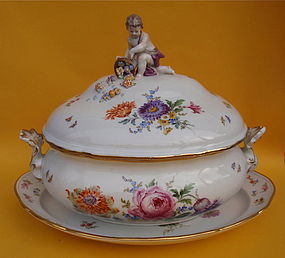
(Below: early Meissen porcelain images)


Monday, December 5, 2011

What's In a Name? Étienne de Silhouette


There's evidence dating back to the first century in Greece of back-lit portraits - what we refer to today as "silhouettes." I have no idea what this art form was named before Étienne de Silhouette. (1709-1767) It is interesting to discover how this art form took his name. After all, there's no historical evidence of his having a talent for such art.

As it happens,he was the Minister of Finance in 1759 in the court of Louis XV. Just like today, he had the ungrateful task of controlling the deficit and raising enough money to finance the Seven Years' War against Britain.

M. Silhouette's austerity moves made him unpopular and gained him a reputation of being a penny-pincher. The phrase, a la Silhouette became a common phrase for anything done on the cheap. In the same period, shadow cutouts were very popular and inexpensive. And that, dear reader, is how these forms of portraits became known as "silhouettes."

Isn't it fun to know the history of words? Do you have a favorite word with a history you know?


Tuesday, November 29, 2011

The Magic Show: What do You Think?

Have you ever been to an art exhibit and found yourself intrigued by a certain painting? So much so that you needed to look at it awhile to allow the mind to interpret what the eyes were seeing? It's that sense that something is "off."

Intriguing the viewer's mind has been the goal of many talented artists. They are like magicians who use sleight of hand to capture the attention of the audience. I thought it would be fun to demonstrate a subtle form of this sleight of hand in a few well-known paintings. (click on image to enlarge)

Degas' painting: "The Bar at the Folies Bergère"


Look carefully. Is that the same girl in a mirror or a different girl?

Manet's painting: "The Waitress"


Where is the person in the top hat sitting?

Degas' painting: "Ballet Rehearsal"


Are we seeing another room in the background or is that a mirror reflecting the rest of the room?

Intriguing, yes?

Tuesday, September 27, 2011

Not a Man of His Times

He is regarded as one of the most important American artists. Still, most people don't know his name or his art work. He was featured on PBS' "American Masters." Yet, there was no stir or conversation about his art and biography. Who was this artist who mattered so much and so little all at the same time?

He was Thomas Eakins (1844-1916). (Notice that the dates of his lifetime coincide with the rise of the avant garde styles of Impressionism and Cubism.)In spite of the era, Eakins was true to his artistic instincts and that meant he was "deeply traditional."

Eakins was true to his believe in the beauty of nature especially the human form. If that meant going against the tide of popular techniques, so be it. That's not to say that he turned his back on what was new and exciting. (He was fascinated with photography and made many inventive contributions to motion studies.)It was more that Eakins disliked trends and affectations.

He studied in Paris, Madrid and Seville. As Eakins traveled, he gained an appreciation of classical painters from earlier times whose portraitures explored the personality of the model.

Eakins' method was to paint portraits very slowly and meticulously. He spoke very little to his model. Most often, the person posing would relax and drop any facade. These portraits rendered a psychological realism not appreciated at the time - especially with all the interest in the new art movements. However, the passage of time changes many things.

Today, in the world of art, Eakins is highly regarded. In 1964, Tom Canaday, art critic for the New York Times wrote:

Today he seems to us to have recorded his fellow Americans with a perception that was often as tender as it was vigorous, and to have preserved for us the essence of an American life which, indeed, he did not idealize--because it seemed to him beautiful beyond the necessity of idealization.

All of the images on this blog are his paintings. What do you think of his work? Did you already know his name and art?


Tuesday, September 20, 2011

Tragic Beauty

While in an art museum, I saw a portrait of such a stunningly beautiful and elegant woman, I determined to find out more about her when I returned home. (The portrait I saw is on the left.)

She was Elisabeth Amalie Eugenie (1837-1898), Empress of Austria and Queen Consort of Hungary. To her family and friends, she was called "Sissi." Even though her father was a Bavarian Duke, Elisabeth and her siblings grew up some distance from the royal court and the strictures of court life.

Elisabeth was 15 years-old, when 23 year-old Austrian emperor, Franz Joseph, came calling on her older sister, Helene. He didn't know Helene and came at the insistence of his domineering mother. However, when the emperor saw Elisabeth, he disobeyed his mother and insisted on marrying Elisabeth. (Helene on left, Sissi on right)

With the marriage, Elisabeth was immersed into the Austrian royal court and her mother-in-law's, Archduchess Sophie, domination. Elisabeth would have 4 children - all taken from her at birth - to be reared under Sophie's rule. Elisabeth wasn't even allowed to nurse. It was among Elisabeth's many sorrows.

Without the tending of her children, Elisabeth turned her attention to two things: her appearance and her adopted country.

Elisabeth was beautiful. She never wore any makeup and yet her inherent beauty was evident in all her portraits. Her hair was so abundant and long that it took 2-3 hours every day just to style it. Her daily cares involved dieting and exercising. She was adored by her adopted countrymen for her beauty as well as her kind demeanor.

She often used the ear of the her emperor-husband to generate clemency for war prisoners or to help the Hungarian cause leading to the Austro-Hungarian Compromise of 1867. Through all, she dealt with many personal tragedies.

First and most important would be the death of each of her children. This would be followed by the deaths of her mother, father, sister and her best friend. It was all too much and at age 52, she chose only to wear black. She also contrived to be away from the royal court as much as possible.

Historians consider that her poor health was psychosomatic as she always felt better when she traveled elsewhere. It was while on her way back from a vacation with her lady-in-waiting that she would meet Luigi Lucheni.

Elisabeth's departure was reported in the news and Lucheni was, in his words, "looking for a royal to assassinate" to gain prominence for his anarchical cause. After identifying her, Lucheni stabbed her once and the wound penetrated her heart. (photo shows her day before assassination)

Her death and funeral were the equivalent of the modern-day response to Princess Diana's death. In the end, all the royal court pomp and ceremony that Elisabeth tried to resist were visited on her.


Monday, September 12, 2011

Van Gogh: In the Eyes of the Beholder

This last weekend on NPR, I listened to an interview of a Dutch musician and artist by the name of Van Eck. He was describing and promoting his album titled, "Van Gogh by Van Eck."

Personally, I have always felt that Van Gogh's painting "The Potato Eaters" was a sad comment on the daily lives of farm peasants in those days. The people in the painting are gathered around a single light, a plate of potatoes and what looks like a tea drink. The conversation between the subjects seems intense. The first time I saw this painting, I felt a sadness for what seemed like a harsh life.

Van Eck saw something quite different. In the interview, he stated that upon his examination of Van Gogh's life, he observed that Van Gogh had a difficult relationship with his father. Therefore, Van Eck felt that based on Van Gogh's family yearnings, the artist wanted to portray a poor family sharing a meal and the happenings of the day with the pleasure of being in the bosom of the family. That is the basis for an upbeat mood in Van Eck's musical piece titled, "One of the Family." (You can listen to a sampling by clicking here and scrolling down to song)

What do you feel when you look at " The Potato Eaters?" If you listened to the music sampling, did you find your opinion of the painting shift?

Wednesday, August 24, 2011

The Wonders (and Turmoil) of The Barnes

In my previous art blog, I described an art collector named Dr. Albert Barnes. (See: "A Most Irascible Art Collector") Prior to Dr. Barnes' death, he set up a foundation to maintain and preserve his art collection.

Dr. Barnes did not like the museum way of exhibiting art. He saw his art collection, horticulture and architecture as a source of education. Therefore, he saw the collection as integral to its location in Merion, PA. (about 5 miles from Philadelphia)

To make sure that all would remain intact, Dr. Barnes set up a foundation. That's how the Barnes' extensive collection of impressionism and post-impressionism arts were treated until recent times.

As it happens, a collection valued at 6 BILLION dollars, is well, real money. Those who, working for the good of the public, decided that it should be open to the public as a museum and have wrested control from Merion, PA. (If you are interested in finding out more about how this control was taken, check out the documentary, "Art of the Steal" )

Below are renderings of the new museum located in Philadelphia. (The Merion, PA. building is above, left)


Besides the Renoir above of the little girl, here are a very small glimpse of the collection including Matisse, Picasso, Modigliani and Cezanne:


A Most Irascible Art Collector


Albert C. Barnes (1872-1951) was an American chemist who made his fortune by the development of a pharmaceutical; which he sold for 6 million dollars. This fortune enabled him to indulge his passion for buying art.

He had a keen eye for art and business. It was the Depression and many a failed businessman had to sell his art collection. As Barnes said, "...my specialty was robbing the suckers who had invested all their money in flimsy securities and then had to sell their priceless paintings to keep a roof over their heads."

In time, Barnes would own 69 Cezannes, 60 Matisses, 141 Renoirs and 44 Picassos. In all, he would amass some 2500 paintings! His collection included artists such as: Degas, Van Gogh, Modigliani, Seurat, and Rousseau.

Barnes had a particular disdain for art historians. He felt that they "stifled self-expression and art appreciation." As a result, in 1923 he opened his home for public viewing of the collection. The public had little understanding of the avant garde art and the critics gave the collection unfavorable reviews.

After that experience, Barnes allowed only limited access to the collection; which resided in his Pennsylvania home. He alone could grant access and he had no qualms about turning down requests from people such as T. S. Eliot and James A. Michener. (and, of course, any art historians or critics).

Before his death, he set up a foundation for his collection. Given his irascible nature, the terms of the Barnes Foundation would prove controversial and even make the news in 2011!

Next Week: The Barnes Foundation Turmoil (and the most beautiful art images.)