Showing posts with label clay. Show all posts

Tuesday, January 8, 2013

Thinking 2012...

Have you heard the expression, "Time seems to go faster as you get older?" Yeah, me, too. I could scarcely imagine that 2012 was over and what had I accomplished? What did I learn? How did it go?

BLOG: My first art blog was in April, 2009. Since then, 172 pages have been posted and those pages have been viewed over 94,000 times. According to Google, the top 3 viewed were:
(1) "Magritte: Son of Man" (archive: March, 2012) with 5,450 views,
(2) "Do-Ho Suh: Part 2" (Oct., 2010), 3560 views - although I have a personal preference for "Do-Ho Suh: The Coat" (May, 2010)
 (3) "Monsieur Monet" (June, 2010) with 3151 views.

Interesting that Magritte gained so many viewers in less than one year. I wonder if he's required reading in art classes.

EXHIBITS: "Progressions" was exhibited twice during the year and various individual pieces were included in other shows.

ART: In the "Access: Greek Isles" 4 new pieces were added - there are now 16 in the series.One piece is almost finished and 4 more are in progress. (You can see the finished works at: http://www.r-atencio.com/gallery/landscapes/access_greece.html


For the "Walkers, Waders and Wondrous" (birds) series, I held a contest to name a piece made with ceramic tiles. The winning title chosen by a panel of interested friends was: "Wind Dancer."

A little Parula was completed for a commission. (All of the finished birds can be seen at: http://www.r-atencio.com/gallery/birds/waders.html

I took an art workshop from Rogene Manas on paper clay. From it, I made a delightful cat/bird birthday gift for a friend.

My confidence to work with paper clay on canvas increased with 9 small birds. The sculpting is finished and I'll paint them as soon as they're dry enough. (On the right is a large clay tile of another bird in progress).

ANNEX:  "Atencio Annex" was named to distinguish items made for reproductions of fine art designs. To the mix of glass cutting boards/trays, mugs, recipe markers, and note cards, there are 4 new coaster designs. You can view all on Etsy - http://www.etsy.com/shop/AtencioAnnex

This posting has been a fun exercise. Sometimes I think that I should work faster and create more, but this look back makes me feel that everything is happening just as it should. Try this exercise and you, too, might be happily surprised. Oh, and let me know what you discovered. Happy New Year! R. Atencio


Wednesday, January 18, 2012

Porcelain Beauty

How often have you heard or read of someone having "porcelain skin?" What comes to mind? Probably something like, white, translucent and flawless as described for the finest porcelain china. Did you know that porcelain didn't start out that way?

Porcelain was created in China starting about 100 CE. The first Chinese experiments were anything but white and flawless. What made porcelain popular was that it could be fired in a very high kiln making it more durable than clay. It would be another 400 years before the Chinese created the porcelain we know today.

Once the Chinese had mastered the means to create white porcelain and control the glazes, artists could create beautiful scenes on vessels and other decorative
pieces. It was China's secret and they guarded it well.

It is said that Chinese porcelain was introduced to Europeans by Marco Polo in 1295 CE. Porcelain pieces were so highly prized by the oligarchy of Europe the they referred to them as "white gold."

The demand for porcelain gave China an exclusive export market. However, exporting to Europe from China was a difficult, arduous and even dangerous process. It was valuable and fragile cargo. European demand and the difficulties of transport led to experimentation to create porcelain locally.

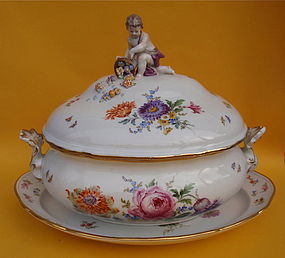
It would be a few centuries of hit and miss until early in the 18th Century when Johann Friederich Böttger of Dresden created a ceramic material that had the strength, whiteness and translucence of Chinese porcelain. European production of porcelain was initiated by the Meissen factory and factories spread through Europe such as: Straffordshire in England, Limoges and Sevres in France.

This story of a scarce and prized item that humans value is repeated many times in our history. Maybe it isn't always necessity that creates inventions. What do you think?

(Below: early Meissen porcelain images)