Showing posts with label atencio annex. Show all posts

Wednesday, November 16, 2022

Jacob Hendrik Pierneef: Father of South African Style

There was a painter born in Pretoria, South Africa of whom most of us know very little. Yet his paintings are auctioned at very high values by those familiar with his works. His name? Jacob Hendrik Pierneef (1886-1957) 


He came to my attention when the collection of Microsoft's co-founder, Paul G. Allen, was being auctioned after his death. The painting that Allen had was a stunner in the breadth, coloration, and drama of the landscape.


Pierneef was of Dutch ancestry. In the 1900s, with the Boer vs. English war, his family decided to return to their roots in the Netherlands. It was there that he took art classes and by the time he returned to Pretoria at 18, was an established artist in painting, linocuts, and etching.


In the years that followed, Pierneff studied South African art and evolved his own style. With the failing health of his wife, he applied himself even more to lecturing and exhibiting for the sake of providing. His efforts paid off handsomely. 


He was commissioned for a 3-year contract to paint the 28 panels of the Johannesburg Train Station, followed by 7 murals in the South African House in London and successful exhibits in several cities and countries.


Oh, and Christie's auction sale price for the one Paul G. Allen owned? Almost $300,000! 


Wednesday, May 18, 2022

Lisa Nilsson: Quilling Tapestries

Artists, who use some of the most available materials to everyone. take paper and glue to an astonishing level. They never cease to intrigue us on how they can do that. An artist who makes us wonder in that way is Lisa Nilsson (1963-)

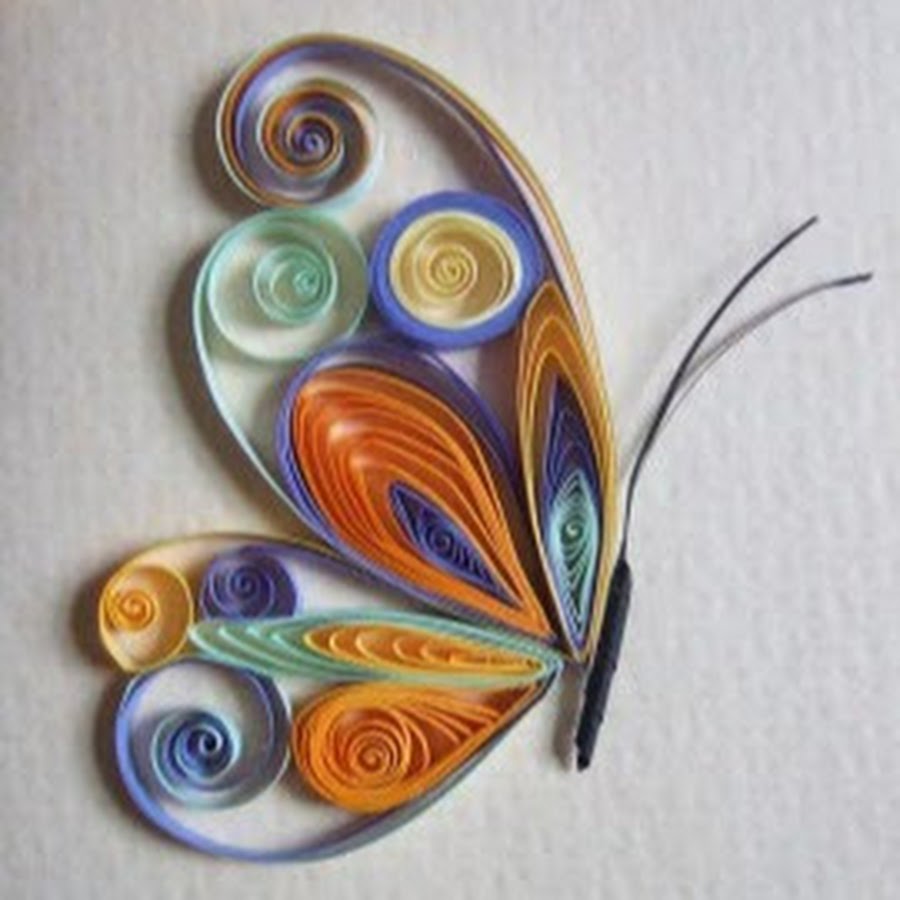
Nilsson creates with a technique known as "quilling." It's defined as an art form using strips of paper that is rolled into a coil, shaped and manipulated. The coil is then glued. It's been used for many centuries to create a "3-D" of flowers, portraits, and other subjects based on the mastery of of the technique.  (Below is a very simplified example of the technique)


The masters, such as Nilsson, have used quilling for so many different subjects as to challenge any belief that there are any limitations to making art with just paper and glue. 


 In her interest to work in series, she presently has 5 series or collections of subjects that she also challenges herself. Since it's not possible to cover all 5 in a single blog, this one will be limited to her "Tapis" series.


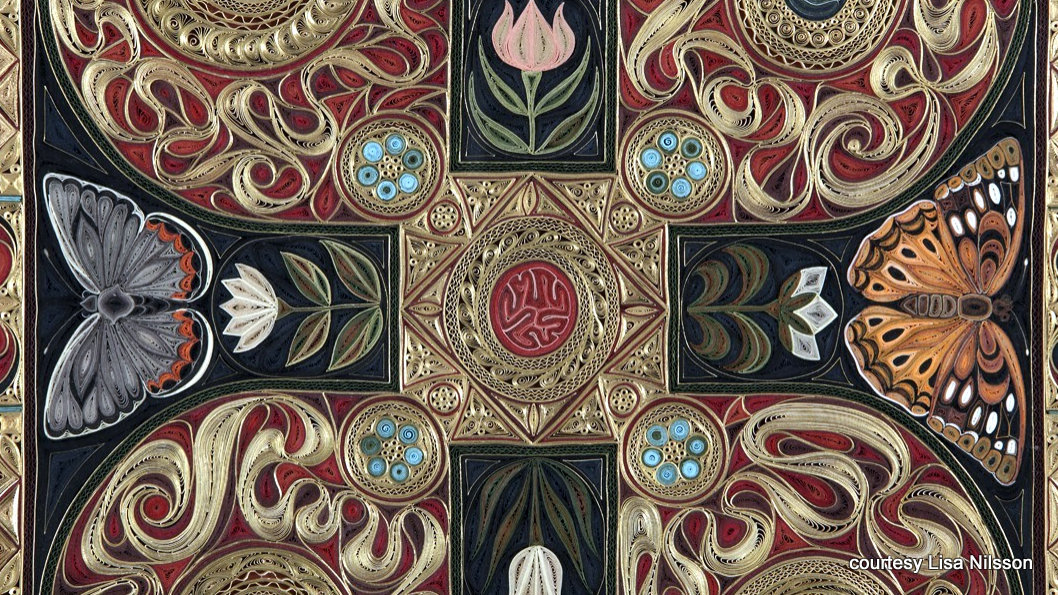
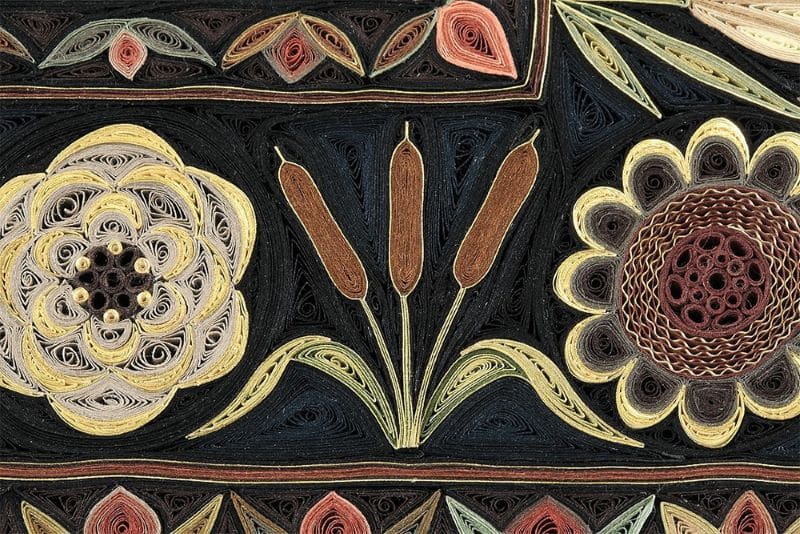
Tapis represents the inspiration she felt in the designs of Persian carpets. Nilsson used her mastery of quilling to create her own wall tapestries. She observed the design elements of a central theme, formal corners and specific borders The process is tedious and takes many months to complete each one. (Sizes vary with the largest ones being 22" x 29") (Below are examples of her finished pieces and close ups of the technique)


Sunday, October 26, 2014

Ursula von Rydingsvard: from Childhood Planks...

In this time where news reports about war uprooting families to "refugee" status, I think about the artist Ursula von Rydingsvard (1942-). She was born during the time the Nazis controlled the area of Germany where she was born. Her father was conscripted into forced labor and her family lived in one refugee camp after another.

In 1950 at age 8, her family settled in the United States. However, she remembered her early years as a displaced person sleeping on planks in camps. As she stated, "It wasn't even a lumber construction. It was plank construction that wasn’t very warm in the winters because there was no insulation. It was just me, sleeping against a plank, and on the other side of the plank was the outdoors."

Von Rydingsvard would go on to graduate with an MFA from Columbia University Her works are on display at MOMA, Whitney Museum, National Gallery of Art, and many other most prestigious galleries and museums. She is also the recipient of many grants and fellowships.


Her sculptural works are monumental in size, scope and are mainly created from cedar planks glued into designs. Below are a few examples that barely reflect a 40-year career in the arts - all reflecting those memorable planks from her childhood. How can we ever know what experiences will inform the artist?


Von Rydingsvard was featured on PBS' wonderful series "Art 21." You can view it at:
http://www.pbs.org/art21/artists/ursula-von-rydingsvard

Tuesday, January 7, 2014

Amid the Beauty of Barcelona


It's both the first and the last - first blog of 2014 and last blog on Spain. This time, it's about fabulous Barcelona.

As you may recall, I was not really interested in departing out of Barcelona. A big city was not where I wanted to be. Barcelona seduced me with art.

 Before I explain how, let's pick up the trip in Granada where I said, "Good-bye to Al Andalucia and the time of the Moors" and boarded the plane that would take me to Barcelona.

Once again, my hosts provided me with info, maps, suggestions and recommendations. Other than Gaudi's architecture, I didn't have a firm plan of what to do or see. As it happens, the hosts' home was perfectly located. In the next block was CaixaForum, a short walk led to Plaza Espanya (the old bullfighting ring - now a mall), and the Metro to the Beach and the Boqueria.

Plaza Espanya (old bullfighting ring doesn't show in top photo - photo of ring in lower picture)


The CaixaForum is an art and social projects museum. The outside reflects the architecture of the factory, but the inside is very modern. On the first floor was a fascinating (and free) exhibit of award-winning inventions to improve the lives of people in 3rd-world areas. The inventions considered everything from clean water filtration to keeping a premature baby warm.These inventions used little to no electricity. Very interesting exhibit. Then, with my paid ticket in hand, I headed upstairs to the art and the major exhibit.


If ever I was given a welcome by Barcelona, it was found in the major exhibit - 67 paintings by one of my favorite impressionists.Imagine 67 paintings by Camille Pissarro! It was heaven for me. He was considered the Father of the Impressionists (see Archives, May, 2011 on the right of this blog.) 

This exhibit was so large and I was  grateful for the seating available in some of the rooms. So many galleries don't provide a place to sit. It's such a good idea in a large exhibit.

There was also something else I'd never experienced in a museum - a separate area divided by a temporary wall. As you walked around the wall, you entered an area with a complete chronology of Pissarro's life, residences and paintingl. In the area, there was a long table and chairs. On the table were published books about Pissarro in a variety of languages. The books were affixed so you couldn't take them, but you were welcome to sit and read. Double heaven - if there is such a thing!

The next day, I took the Metro to Las Ramblas - a street about 3/4 mile in length reaching from the seaport to the city center. It's a street that's always in motion with tourists, locals, floral stands, visual and performing artists and a huge indoor market - La Bouqueria. What a busy and exciting world! Here are a few images that portray the feeling of being there.

Las Ramblas:


La Boqueria:


It was on a side street off the main drag that I saw Güell Palace designed by Antoni Gaudí in the late 1800s as a mansion for wealthy industrialist. It is the only building Gaudi' ever fully finished. The exterior was a beautifully wrought and well-crafted Art Nouveau style. Below are images of the exterior, interior and the whimsical chimneys on the roof.


In Barcelona art abounds. Art exists naturally in the culture. I was so impressed with some of the visual art I saw on Las Ramblas and other places, my regard for Barcelona shifted from a way to depart for home to one of wanting to come back and take art classes. And so I left Spain with a backward glance and a desire to strong desire to return for a longer stay.

Tuesday, August 13, 2013

Is it REALLY Black?

When I was trying to advance my understanding of high-contrast black and white (think Rembrandt), I created a series titled, "Hidden World (at the White Lotus)." After I finished the originals, I took them to my favorite giclee (fine art prints) artist, Janet Smith of Sterling Editions, and asked her to recreate the colors.

Seems I put a very hard task in front of her. She commented that there were many shades and tones of black in each painting.

What does that mean? According to sources, black is the absence of light. Black alone makes for a lack of information to the viewer. Here are paintings by some of the masters. Do you notice what they did to give form and focus (or unfocus) to the object?
(click on image to enlarge)

"Portrait in Black & Grey" - James McNeil Whistler


"The Brawl" - Giacomo Ceruti


"Portrait of a Bearded Man" - Giorione Barbarelli


"Petunia - Purple & Black" - Georgia O' Keeffe


"The Bellelli Family" - Edgar Degas


(Next blog will be about Pierre Soulages. He is a 91-year old French painter who has been painting in black since the 1970s.)

Wednesday, October 3, 2012

Does Art Still Shock?

What is shock art? According to Wikipedia it is "...contemporary art ...disturbing imagery, sound or scents to create a shocking experience." However, I contend that art has been shocking the viewers for much longer. After all, being contemporary can mean contemporary to the times.

Consider Daumier's "Rue Transnonain" (1834)

Then there was Manet.  For example, consider the effect in 1863 of  his "Luncheon on the Grass." 

In the early 20th Century, there was Duchamp's "Fountain." (1917)


  Today, these works created a hundred years ago or so, do not carry the same effect on the public.

So, what shocks today? Journalists have written that maybe we've reached the end of what can be described as shock art. What do you think? Are artists no longer able to shock us?