Showing posts with label pissarro. Show all posts

Wednesday, July 6, 2022

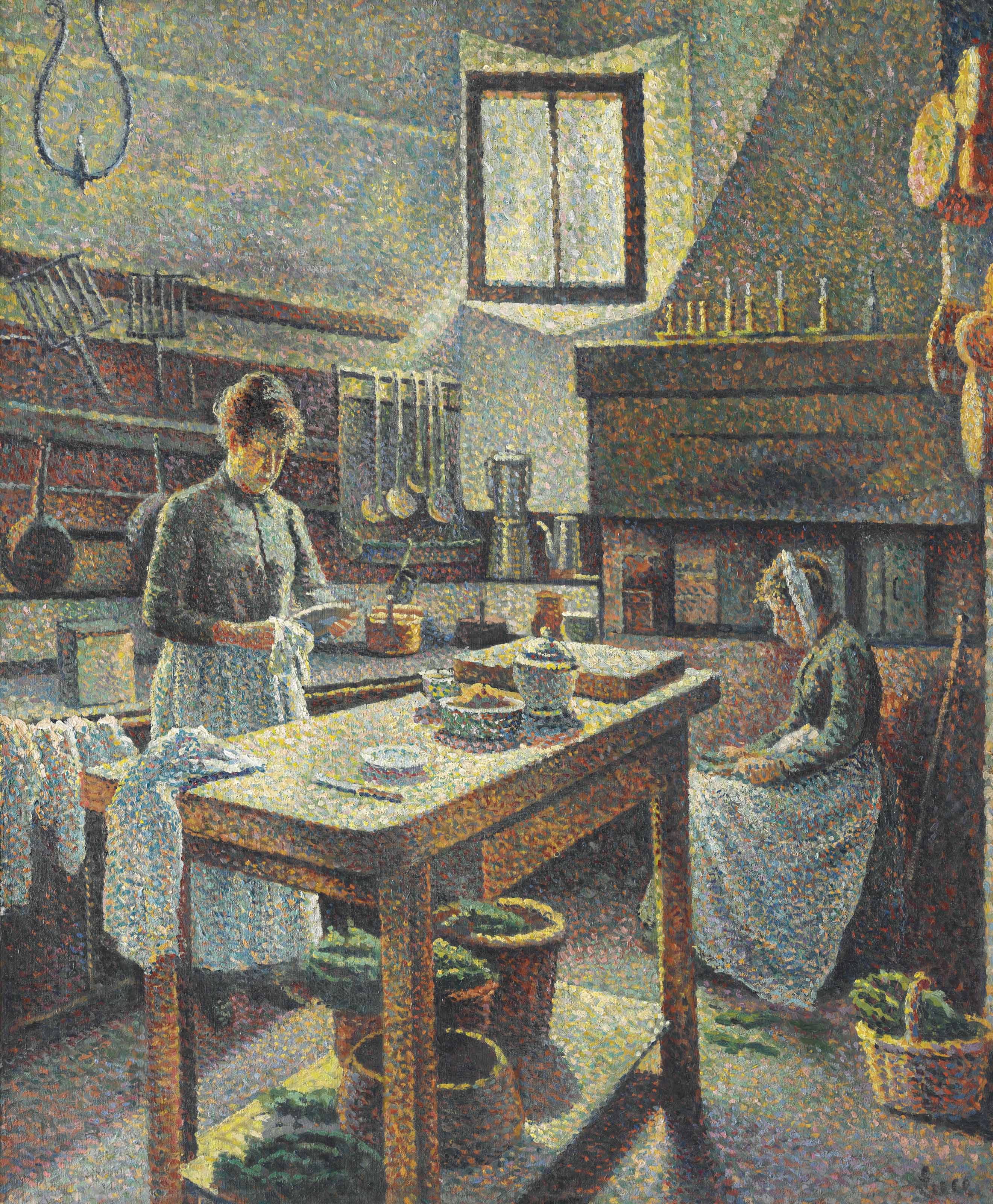
Maximilien Luce: Artist, Lithographer & Anarchist


Many of the Impressionists saw what the Industrial Age was doing to the souls of men. All these workers were cogs in a machine which required them to work long hours for very little pay. This work was often dangerous and if the workers were injured, well, too bad. 


Of those times, there were a few artists who became overtly sympathetic to the plight of the working poor. They were: Camille Pissarro, who fled France, Paul Signac and Maximilien Luce.


I was familiar with the works of Pissarro and Signac, but knew nothing of Luce. That is, until I had to write an essay on an impressionist painter. Knowing the teacher would be inundated with papers on Monet, Degas, and Van Gogh, I researched and found Luce.


Luce was a wonderful and interesting find - painter, lithographer and anarchist. He painted landscapes and urban life. (Along with Seurat and Signac he originated pointillism - a technique where small dots of color optically blend to create an image. ) 

  Luce was also known for painting subjects of social realism - war, citizen revolts, industry's effects on people and the land, and the plight of the those out of power. These were the images that would lead to his arrest, trial and conviction - the very outcome that made Pissarro flee to London. (Google: "Trial of the Thirty")


However, even after release Luce continued his political resistance in his paintings albeit more subtly. At age 76, he was elected President of the Société des Artistes Indépendants. He soon resigned in protest against the society's policy to restrict the admission of Jewish artists. (Below: He painted the light leaning left in the manner of representing Socialism in a scene divided between bucolic nature and the inhumanity of the smoke and soot belching out of the smoke stacks)


He always stood by what he believed. Could this be why we know so little of him in the history of Impressionism? What do you think?


Monday, February 17, 2014

Camille Pissarro: A Loving Tribute

I am in love with Camille Pissarro (1830-1903). I have been for a long time. No, not romantic love, more like the adoration of a child sitting at the feet of a wise and experienced father.


You can imagine my joy to find an exhibit in Barcelona of 67 of his paintings. 67! I moved up close to his paintings trying to find him in his colors, impasto and other techniques. (I think I drove the security guards crazy.) Steeped in the environment of his paintings, I thought about his amazing output, political courage and gentle, fatherly personality.

His work ethic was boundless. No matter what was happening in his personal life, he painted. He painted outdoors as much as possible and mostly without consideration to the weather. When he could not paint outside, he stood at the window and painted.

Even in later life, with his vision impaired from a recurring eye infection, he painted. His industriousness was enough to eventually support his large family. (Wife, 8 children and household help)


Art was central to him, yet  Pissarro was a well-read and informed man. He understood the original meaning of anarchy (without a monarch/leader). Although he believed in non-violence, his leftist leanings brought him to the attention of the police. It was very dangerous for Pissarro for he had known artist who were jailed for their leftist beliefs. (Trial of the Thirty, 1894)

Another reason I admire him is the consistent description of him by his contemporaries as "fatherly." Gauguin, who studied with him, referred to M. Pissarro as "...one of my masters and I would not deny him." Cezanne walked miles just to paint with Pissarro. Mary Cassatt referred to him as "a teacher who could have taught the stones to draw correctly." It was his " gentle, kind, and warm-hearted personality" that held the Impressionists together.

The Impressionist Group consisted of 15 artists - each different in personality and temperament from the others. Yet, it was Pissarro who held the group together. Not only would his legacy be his role as "Father of the Impressionists," but also as the creative force of children and grandchildren who followed him in art.

Most notable among his progeny are: His son, Lucien Pissarro, a famous printer, grandchildren Claude Bonin-Pissarro, Henri Bonin-Pissarro, and Orovida Pissarro, all painters, and great grandchilden, Frédéric Bonin-Pissarro, painter and Joachim Pissarro, Head of Curator of Drawing & Painting, MOMA as well as professor of art at Hunter College.

Here's a glimpse of his art - another reason I am in love with him. And what is your take on M. Pissarro?


Tuesday, January 7, 2014

Amid the Beauty of Barcelona


It's both the first and the last - first blog of 2014 and last blog on Spain. This time, it's about fabulous Barcelona.

As you may recall, I was not really interested in departing out of Barcelona. A big city was not where I wanted to be. Barcelona seduced me with art.

 Before I explain how, let's pick up the trip in Granada where I said, "Good-bye to Al Andalucia and the time of the Moors" and boarded the plane that would take me to Barcelona.

Once again, my hosts provided me with info, maps, suggestions and recommendations. Other than Gaudi's architecture, I didn't have a firm plan of what to do or see. As it happens, the hosts' home was perfectly located. In the next block was CaixaForum, a short walk led to Plaza Espanya (the old bullfighting ring - now a mall), and the Metro to the Beach and the Boqueria.

Plaza Espanya (old bullfighting ring doesn't show in top photo - photo of ring in lower picture)


The CaixaForum is an art and social projects museum. The outside reflects the architecture of the factory, but the inside is very modern. On the first floor was a fascinating (and free) exhibit of award-winning inventions to improve the lives of people in 3rd-world areas. The inventions considered everything from clean water filtration to keeping a premature baby warm.These inventions used little to no electricity. Very interesting exhibit. Then, with my paid ticket in hand, I headed upstairs to the art and the major exhibit.


If ever I was given a welcome by Barcelona, it was found in the major exhibit - 67 paintings by one of my favorite impressionists.Imagine 67 paintings by Camille Pissarro! It was heaven for me. He was considered the Father of the Impressionists (see Archives, May, 2011 on the right of this blog.) 

This exhibit was so large and I was  grateful for the seating available in some of the rooms. So many galleries don't provide a place to sit. It's such a good idea in a large exhibit.

There was also something else I'd never experienced in a museum - a separate area divided by a temporary wall. As you walked around the wall, you entered an area with a complete chronology of Pissarro's life, residences and paintingl. In the area, there was a long table and chairs. On the table were published books about Pissarro in a variety of languages. The books were affixed so you couldn't take them, but you were welcome to sit and read. Double heaven - if there is such a thing!

The next day, I took the Metro to Las Ramblas - a street about 3/4 mile in length reaching from the seaport to the city center. It's a street that's always in motion with tourists, locals, floral stands, visual and performing artists and a huge indoor market - La Bouqueria. What a busy and exciting world! Here are a few images that portray the feeling of being there.

Las Ramblas:


La Boqueria:


It was on a side street off the main drag that I saw Güell Palace designed by Antoni Gaudí in the late 1800s as a mansion for wealthy industrialist. It is the only building Gaudi' ever fully finished. The exterior was a beautifully wrought and well-crafted Art Nouveau style. Below are images of the exterior, interior and the whimsical chimneys on the roof.


In Barcelona art abounds. Art exists naturally in the culture. I was so impressed with some of the visual art I saw on Las Ramblas and other places, my regard for Barcelona shifted from a way to depart for home to one of wanting to come back and take art classes. And so I left Spain with a backward glance and a desire to strong desire to return for a longer stay.

Tuesday, March 8, 2011

Tubes, Easels, and Railroads

Did you see "The Girl with the Pearl Earring?" If so, perhaps you remember that she began assisting the Dutch artist, Vermeer (1632-1675), in grinding the pigments and adding the oil to make his paints.

In those days, oil painters could only sketch outdoors. The materials they needed to schlepp were too cumbersome to actually paint the scene away from their studios. Reference sketches left the artist relying on rough outlines and memory. This led to final paintings that were fanciful especially in the backgrounds and figures.

Three inventions released oil painters to paint directly from nature. They were: industrially-mixed paint in tubes, light-weight, portable easels and the speed of railroad travel.

Starting in the late 19th century,artists could gather up their supplies, board a railroad and arrive at a place in the country to paint directly on canvas - even to paint a final version.

Painting directly outdoors became known as "en plein" air or "in the open air." It was a wonderful opportunity for artists and generated some of the finest Impressionist paintings we treasure. (Monet, above; Pissarro, below left, Morisot, below right)

Today, there are plein air painting groups and workshops everywhere. So when someone tells you it is a plein air painting, you'll be able to shake your head and say, "I thought so."

Monday, October 4, 2010

The Impressionist's Hero: M. Durand-Ruel


Last week the blog was about Theo Van Gogh, who did everything he could to promote and sell the art of Vincent as well as the other Impressionists. As I mentioned then, the art world purchased art and gave commissions to artists whose work reflected the stringency of the Academie de Beaux-Artes. By 1860, certain artists began to rebel against the rigidity of being told what and how they were to paint.

These artist started their own exhibitions in the Salon de Refuse. Their exhibits in Paris were considered outrageous and even scandalous. The art was ridiculed and, for the most part, no one was interested in buying the art. Against that background, these artists found support in many ways from Paul Durand-Ruel (1831-1922).

Paul's father had been art dealer and in 1865, Paul took over the business. He believed deeply in the Impressionists. He supported the artist by buying the art outright*, gave stipends to the artists, and held solo exhibitions. Eventually, some artwork sold, but not in any serious way in France.

However, during 1886 and 1887, he launched exhibits in the United States and experienced great success. He so appreciated the open-mindedness of the Americans for impressionism that he was quoted as saying, "The American public does not laugh. It buys!"

From 1870 until his death, Paul became the best known art dealer for French Impressionism in the world. Most of the Impressionists struggled financially. Imagine how much worse it would have been without M. Durand-Ruel's support!
*Between 1891 and 1922, Paul Durand-Ruel purchased close to 12,000
pictures, including
more than 1,000 Monets, approximately 1,500 Renoirs, more than 400 each by Degas and Sisleys, about 800 Pissarros, close to 200 Manets and appx. 400 Mary Cassatts. "...
My craziness has become wisdom. To say that if I had died at sixty years old, I would have died crippled in debt, insolvent amongst undiscovered treasures…