Showing posts with label landscapes. Show all posts

Wednesday, November 15, 2023

William Degouve de Nuncques: Autumn Scenes


The change of time and the darkness coming so early has me thinking that I should put on my pjs and hunker down under a warm blanket, but it's only 5 PM! I searched for an artist who might have known what autumn feels like. Found! He was William Degouve de Nuncques, (1867-1935) who was a Belgian artist.

 Degouve de Nuncques was an artist who found his own way. He did go to art school for awhile, but preferred to be self-taught. He was influenced with the artists with whom he shared a studio.Those were Dutch artist, Jan Toorop (whose painting of the Crucifixion is the most stylized I've ever seen) and Belgian artist, Henry de Groux.

 For most of his life, he was regarded as a painter of post-impressionist,atmospheric landscapes. That is why he seemed so appropriate for this time of year. 


While his subjects and style changed in the 1900s, partially due to his loss of use of one hand, this blog will be on his works during the time before.


Wednesday, July 5, 2023

The Younger Victor Muller: Timeless Art


Sometime ago, I saw the art of Victor Muller and noted that he might be the subject of a future art blog. Well, the time had come and I opened a search. I was curious as to why his art didn't look anything like what I had expected. Turns out that the name is a bit common. 

There's a businessman as well as an artist by that name. Victor Muller, the artist, was born in 1829 Germany and the Victor Muller, the artist I was researching, was born in 1976 Netherlands - quite a difference - as is their art.

Present-day Muller received his MFA from the Willem de Kooning Academy. His art is influenced by many of the old masters, such as: Vermeer, Fra Angelico and, most of all, Giovanni Bellini. Yet, he has distilled his own subjects and signatures works.


Interestingly, he often combines landscape backgrounds with still life foregrounds. He does this to create a "timeless atmosphere." It also seems to create a sense of surrealism where not only time, but also movement don't exist.


This blog is a sampling of his works with variations on his masterly works that are collected all over the world.


Wednesday, June 21, 2023

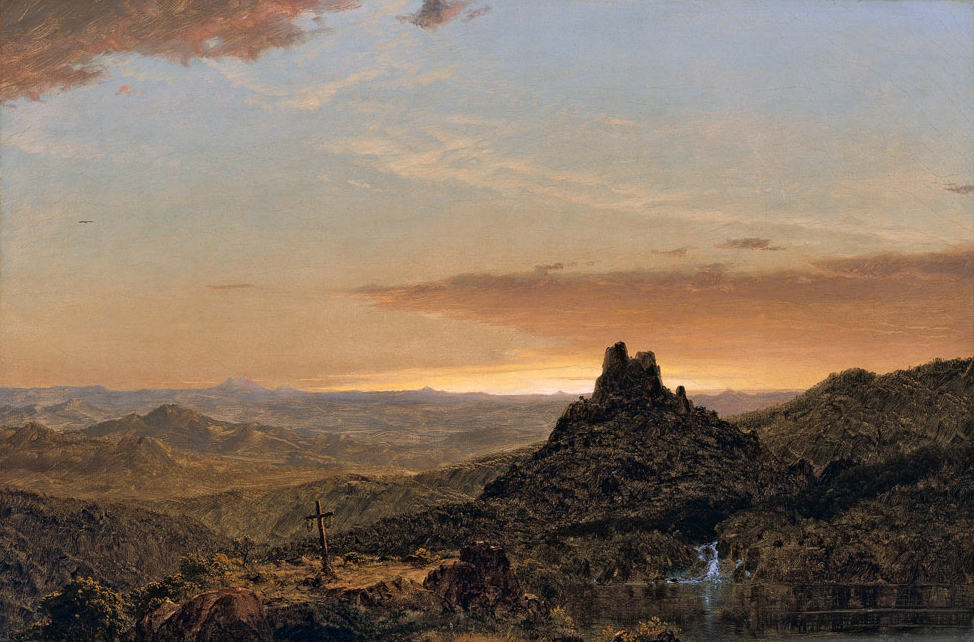
Frederic Edwin Church: Fame & the Hudson River School

Sometimes on the PBS' Antique Roadshow there will be a pastoral scene of water and a valley. The appraiser will say, "This is from the Hudson River School." However, it wasn't an actual school. It was a group of mid-19th century landscape painters of great talent who were inspired by the area around the Hudson River. It was a matter of artists capturing pastoral scenes which were quickly vanishing. 

Arguably, the most famous painter of that style was Frederic Edwin Church (1826-1900). With an eye for drawing detail, he apprenticed for two years with the "school's" founder. By age 20, he sold his first painting for $130 ($4700 in today's dollar!) At age 22, he was elected the youngest member of the National Academy of Design.

 In time, Church would widen his subjects by travel. He not only traveled through the eastern USA, but also went several times to South America. His method would be to sketch all the detail on site and then use these sketches and his memory to recreate large paintings in his studio. It was such a trip with an Arctic explorer that led to his dynamic, "The Icebergs."

His paintings were so large that they were shown with the bottom of the frame on the floor. Viewers paid an entry free and sat on benches to see the entire painting. In this way, Church re-created the view as if looking out the window at the scene. 

Church was a very successful artist, both in recognition 

 and financially. He took his family to Europe and the Middle East where he found more influence in Greece architecture than in the art of Italy and France. On his return, he purchased 18 acres where he supervised the building of a hilltop home ("Olana") and enjoy the magnificent views of the Hudson River. (His home is conserved as the Olana State Historic Site. You can purchase tickets to view his home & studio.*) 

Alas, as often happens with time, Church's art was considered dated. However, post WW2, some 45 years after his passing, the interest in his works would be revived by an exhibit titled, "Hudson River School" at the Art Institute of Chicago. Today, his works sell in the millions.

*(There is an award established by the Olana Partnership in the name of Frederic Church to individuals and organizations that make extraordinary contributions to art and culture.)


Wednesday, May 15, 2013

Édouard Cortès:The Parisian Poet of Painting

Édouard Cortès (1882-1969) was a post-Impressionist painter. Exhibiting just after the Impressionists, the public and art critics were more accepting of this form of painting. After his graduation from the École des Beaux-Artsin Paris, Cortès received recognition at his first exhibition. However, that's not to say that life was  a series of artistic accolades for Cortès.

You see, Cortès' was a pacifist. As with the Impressionist who went to jail or fled for their criticism of the industrial system, Cortès felt the cold grasp of World War I. Even though he was 32 years old and had a family, he was compelled to fight in the infantry. He was injured in battle, but refused the highest French recognition -
Légion d'Honneur.

This man of peace wanted nothing more than to paint the beautiful scenes around him. His most famous and desirable paintings are of Paris. He painted Paris in all seasons. With the exception of the transportation and the fashion, these still show Paris in all its glory. Enjoy this exceptional painter and Paris. (click on image to enlarge)