Showing posts with label impressionists. Show all posts

Wednesday, September 27, 2023

Hayashi Kodenji: At the Peak of Japanese Cloisonne Enamel

 Last week's blog was a lead-in to this week. As I previously mentioned, the Impressionists were inspired by the art in painting, woodblocks, and paper that was being imported from Japan. There was another form of Japanese art that was captivating them. It was the beautiful and excellent cloisonne enamel vases made by Hayashi Kodenji (1831-1915)


Cloisonne is French for "closed." It's an ancient process where metal strips or wire (usually gold or silver) outline a design. The ancient Egyptians used the process and then put precious or semiprecious stones in the enclosed area. However, for the purposes of objects practically used, powdered enamel filled the open areas and then the whole object was fired in a kiln. 


Kodenji was a master of the technique.In his Nagoya studio, he was also a brilliant marketer. The story goes that he literally walked his vases to the port of Yokohama to place them carefully on the ships heading to Paris. He made sure they were featured at the 1868 & 1878 Paris and 1873 Vienna Expositions. 


The Europeans were quite taken with the beauty and quality of the workmanship. Kodenji, along with a few other Japanese cloisonne enamel masters were held in very high regard.


 (When you look at some of the floral designs do you see where Monet's Giverny gardens might have been conceived?)


In the way of passing the knowledge to the next generation, Kodenii's son, Hayashi Kodenji II, (1859-1922) would continue to operate the Nagoya studio. It's reported that the father and son worked together for 40 years and that makes it difficult to differentiate. I'd like to think it was collaborative. In any case, Nagoya Studios won at many exhibitions.

 The high demand meant many cloisonne enamel artisan studios thrived in Japan in what was to be the Golden Age of Japanese cloisonne enamel. The last studio is now gone. The archives, tools and enamel materials are preserved in the Museum of Kyoto. 


Wednesday, July 6, 2022

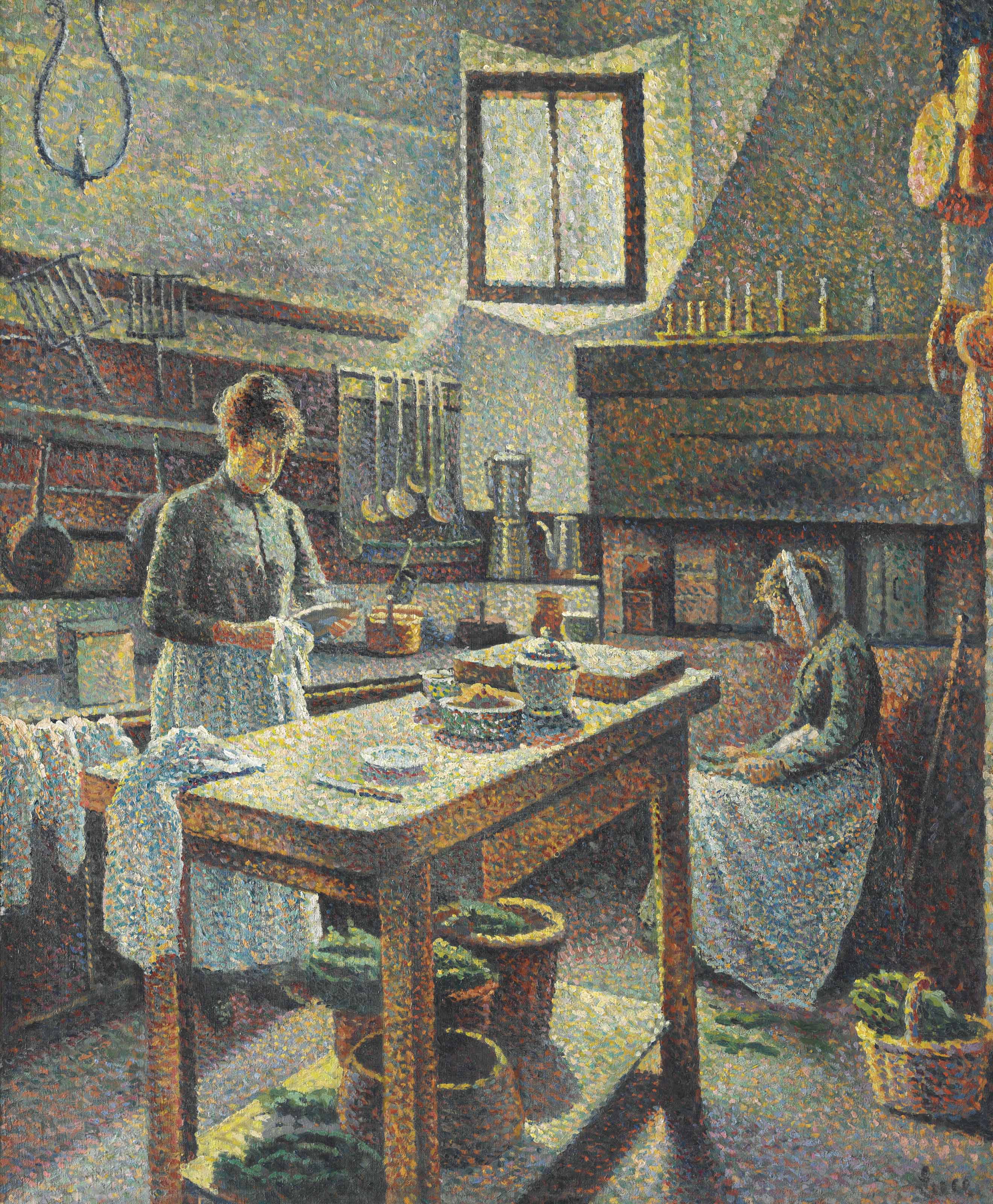
Maximilien Luce: Artist, Lithographer & Anarchist


Many of the Impressionists saw what the Industrial Age was doing to the souls of men. All these workers were cogs in a machine which required them to work long hours for very little pay. This work was often dangerous and if the workers were injured, well, too bad. 


Of those times, there were a few artists who became overtly sympathetic to the plight of the working poor. They were: Camille Pissarro, who fled France, Paul Signac and Maximilien Luce.


I was familiar with the works of Pissarro and Signac, but knew nothing of Luce. That is, until I had to write an essay on an impressionist painter. Knowing the teacher would be inundated with papers on Monet, Degas, and Van Gogh, I researched and found Luce.


Luce was a wonderful and interesting find - painter, lithographer and anarchist. He painted landscapes and urban life. (Along with Seurat and Signac he originated pointillism - a technique where small dots of color optically blend to create an image. ) 

  Luce was also known for painting subjects of social realism - war, citizen revolts, industry's effects on people and the land, and the plight of the those out of power. These were the images that would lead to his arrest, trial and conviction - the very outcome that made Pissarro flee to London. (Google: "Trial of the Thirty")


However, even after release Luce continued his political resistance in his paintings albeit more subtly. At age 76, he was elected President of the Société des Artistes Indépendants. He soon resigned in protest against the society's policy to restrict the admission of Jewish artists. (Below: He painted the light leaning left in the manner of representing Socialism in a scene divided between bucolic nature and the inhumanity of the smoke and soot belching out of the smoke stacks)


He always stood by what he believed. Could this be why we know so little of him in the history of Impressionism? What do you think?


Thursday, June 9, 2022

Raymond Wintz: The Light of Brittany

 Raymond Wintz (1884-1956) was one of those "in-between" painters. His style was described as being between what was known as "realism" in those times with a touch of "impressionism." It could've been because that although he was Parisian-born and trained in art, he chose to live in another part of France.


Wintz decided to settle in Brittany. Perhaps it was for the quality of the light. After all, he was known as the "painter of light." Whatever else, the combination of the light and the closeness to the sea from his windows proved very inspiring.


His most famous painting from his time in Brittany is titled, "The Blue Door."


It's still available in prints and there's no wonder. Who wouldn't love to go on vacation to the seashore and open the door of a rented villa to such a scene? Imagine stepping out in the morning with your coffee and croissant to such a view!


With all of his paintings of Brittany, not only do you feel the wind and the sea, but the lives of the Bretons and their distinct Celtic culture having more in common with the Welsh, Irish and Scottish, who have all retained their language into modern times.

Here's more of the people and the land that inspired Wintz to produce some of this most well-known works:


Wednesday, May 15, 2013

Édouard Cortès:The Parisian Poet of Painting

Édouard Cortès (1882-1969) was a post-Impressionist painter. Exhibiting just after the Impressionists, the public and art critics were more accepting of this form of painting. After his graduation from the École des Beaux-Artsin Paris, Cortès received recognition at his first exhibition. However, that's not to say that life was  a series of artistic accolades for Cortès.

You see, Cortès' was a pacifist. As with the Impressionist who went to jail or fled for their criticism of the industrial system, Cortès felt the cold grasp of World War I. Even though he was 32 years old and had a family, he was compelled to fight in the infantry. He was injured in battle, but refused the highest French recognition -
Légion d'Honneur.

This man of peace wanted nothing more than to paint the beautiful scenes around him. His most famous and desirable paintings are of Paris. He painted Paris in all seasons. With the exception of the transportation and the fashion, these still show Paris in all its glory. Enjoy this exceptional painter and Paris. (click on image to enlarge)


Monday, April 16, 2012

Van Gogh: Suicide or Homicide?


It's long been held that Vincent Van Gogh (1853-1890), died in the hay field he was painting by shooting himself. However, that wasn't really the end of the story of Van Gogh life.

After shooting himself in the chest, Van Gogh walked almost two kilometers from the field into town with the bullet wound. It is believed that the bullet had ricocheted off his ribs, missed all his internal organ and rested in his spine. He was attended by two doctors, but neither had the surgical skills to remove the bullet.
Van Gogh lingered for about 30 hours before he finally succumbed to an infection from untreated wound. This is the suicide version.

Now, the homicide version:

In their new book, "Van Gogh, The Life," authors Steven Naifeh and Gregory White Smith contend that Van Gogh was murdered. ( These authors have top credentials as previous Pulitzer prize winners who thoroughly researched their subject.) They drew their conclusion based on the following facts:

(1) No revolver was ever found,
(2) The entry of the bullet was not near the heart and was at a strange angle for a self-inflicted gunshot,
(3) Why weren't his painting supplies found in the hay field if he was painting as he claimed?
(4) Why was there rumor in town that he had been shot accidentally by two boys? (One boy, Rene Secretan,confessed in 1956 that he and his brother had known Van Gogh the summer of 1890 and had tormented him mercilessly. He also said they borrowed a gun from the owner of the tavern to play Wild West, but claimed Van Gogh took it from them.)

Now, comes the controversy. You see, dear Reader, at age 37 Van Gogh was lying on his death bed when he said,"Do not accuse anyone,it is I who wanted to kill myself". Naifeh and Smith claim that Van Gogh was depressed and tired of living and he didn't want to implicate the boys for cutting his life short. This proposal has raised much controversy among historians.

So what do you think suicide or homicide?

Monday, August 15, 2011

Manet or Monet - Who's Who?

I was telling a friend about seeing a "Manet" and she said, "Don't you mean Monet?" I can understand the confusion. Two French impressionist painters with similar names, living at the same time who were also personal friends. It can seem confusing, so let's see if we can find the differences that distinguished Manet from Monet.

Since Edouard Manet (1832-1883) was born first, we'll start with him. Manet created the foundations for Impressionism. He walked the line between Realism and Impressionism. He painted directly from models to canvas as Realism required, but as an Impressionist, he worked quickly and completed the painting in one seating. He did not suffer the tedium of waiting for a layer of paint to dry and then adding another layer. No. Instead he applied the exact color directly and, if he didn't like it, he scraped it off and tried again.(Portrait of Berthe Morisot, Impressionist Artist)


By contrast, Claude Monet (1840-1926) was not interested much in the subject or model and preferred to consider the colors of the object. In other words, it wasn't a tree or grass. It was a square of green, a rectangle of blue, or a line of red. Monet would paint the same scene be it his gardens, a church or a stack of hay as changing bits of color.

How to tell whose work it is? If it is painted with dabs of color, you are looking at a Monet. If instead you are looking at models in a loosely painted style, it's a Manet.

Now, try your hand at identifying if the paintings below are Manet or Monet.


Tuesday, May 31, 2011

Russian Impressionism- Part II: The Soviet Influence


Last week's subject was the French Impressionists' influence on Russian artists before the Russian revolution. This week's blog is how Russian artists continued to evolve while isolated behind the Iron Curtain.

When the Communist Party came to power, they suppressed all forms of art that had roots in foreign techniques or style. In spite of these dictates, Russian artists managed to use the techniques of impressionism in combination with subjects acceptable to the Soviets.

The result was a uniquely Russian style. When the Iron Curtain fell away and the art of 5 decades (appx. 1930-1980) was finally available to view, it was clear that Russian art had developed in a very different way than in the West.

The West had evolved from Impressionism into styles such as Cubism, Fauvism, and Expressionism. By contrast, Russian artists used a more realistic approach.

They portrayed the lives of the Russian citizens. Their art was realistically full of optimism, hope and dreams of the ordinary people. The style and subjects are now referred to as "Russian Impressionism."

Have you seen Russian Impressionism before? What do you think of this style that continued into the 1980s?


Tuesday, May 24, 2011

Russian Impressionism - Part 1: The French Influence


In my blog of May, 2010, I described my experience at the D'Orsay Museum in Paris and the special exhibit of Russian Impressionism. It made me aware of the influence of the French Impressionists on Russian artists.

Russia's art history was very much linked to the rest of Europe - until the Soviets came to power. Prior to that, Russian nobility preferred the realism and representational art works - just as the rest of Europe before the French Impressionists.

With the rise of Impressionism, Russian artists found new inspiration and direction. Like some of the French anarchist artist of the Industrial Age (Archive: Luce, Feb. 2010), Russian artists not only painted landscapes but also the poverty and suffering of the people.

When the iron curtain fell, Russian artists were prohibited from painting modern art for the "elitist." Instead, they were required to paint realistically so that it was understandable to the masses.

Interestingly, Russian art evolved to generate modern art paintings together with subjects acceptable to the Soviet government. This combination is known as "Russian Impressionism" and is the subject of next week's blog.